
Wharton County Criminal Court Cases
Wharton County felony prosecutions are assigned to the 23rd or 329th Judicial District Court. The District Clerk is custodian of those indictments, docket events, orders, judgments, and sentences. Class A and B misdemeanors go through the constitutional County Court, whose file is kept by the County Clerk. Fine-only Class C charges and city ordinance cases stay with the issuing municipal or justice court. A searcher must therefore know the charge level or issuing court before choosing a portal.
The arresting officer's intake charge is only the first entry in the trail. A prosecutor may decline it, amend it, replace it through an information, or present a felony to a grand jury. The filed court record is the best source for the prosecution and outcome. The broader Wharton County arrest lookup explains why a booking entry can appear before any clerk has opened a case.
Wharton County Felony Records
Felony researchers should start at the Wharton County District Clerk. The public counter is at 103 S. Fulton Street, Wharton, TX 77488, beside the courthouse area. Posted hours are 8:00 a.m. to 4:30 p.m. on weekdays, and the office can be reached at 979-532-5542. Older, archived, restricted, or document-light online results should be checked with that office.
The District Clerk's official page is also the source for its linked felony iDocket channel. This view of the District Clerk source shows why the local office remains central even when a vendor index is available.
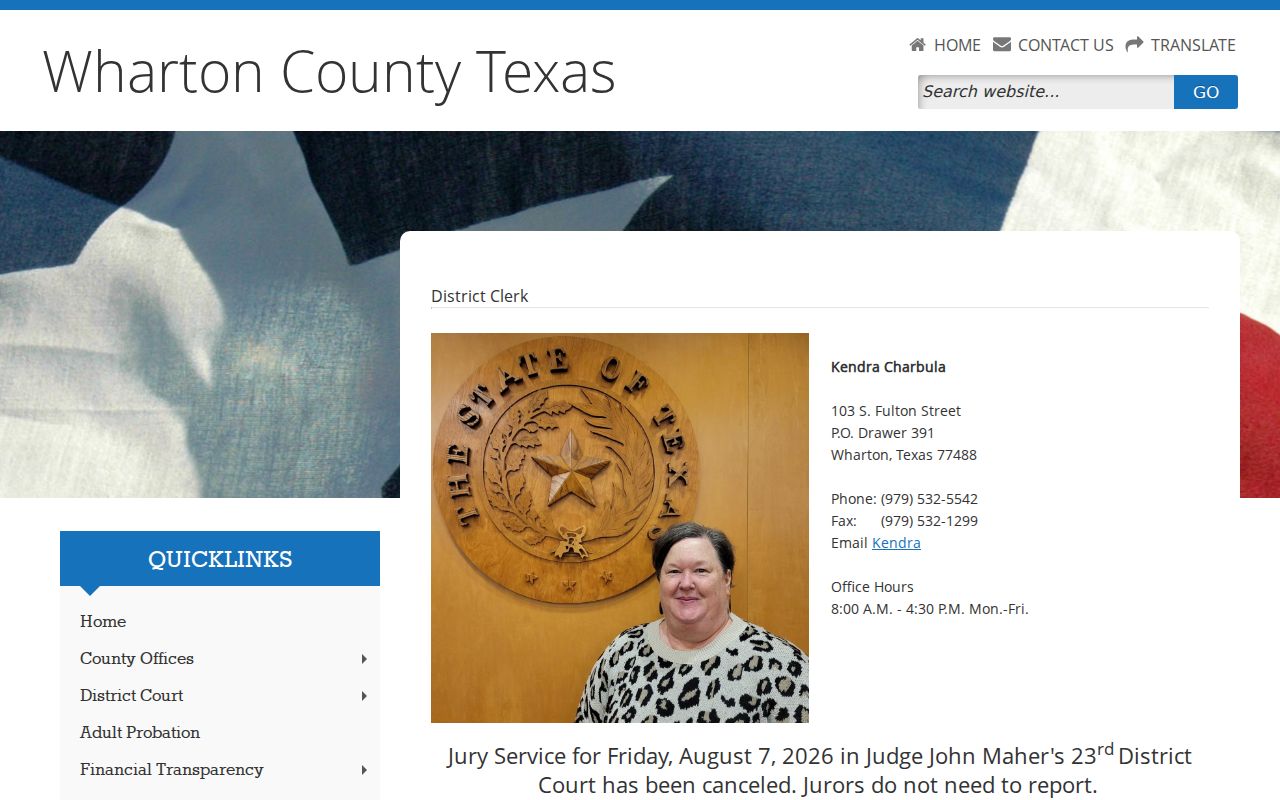
The clerk page connects Wharton County felony case searches with the office that can supply the actual indictment, judgment, or certified copy.
Searching Wharton County Case Records
Begin with the offense level, not just the person's name. Then follow the appropriate official clerk page to its iDocket link. Online access can vary by vendor gate, case age, document type, and user role. A result is a locator rather than a substitute for the filed paper or image. Use re:SearchTX as a statewide supplement and return to the local custodian when a document, disposition, or older case is absent.
- Choose the District Clerk for a felony or the County Clerk for a Class A or B misdemeanor.
- Search the linked system by cause number when known, or use the full party name.
- Compare the court, filing date, charge, and other identifiers before opening the docket.
- Read the event line for the charging instrument, plea, motions, disposition, judgment, and sentence.
- Call or visit the correct clerk to request an authoritative or certified document.
The re:SearchTX platform provides statewide electronic court access, but clerk participation and document visibility are not uniform. The captured statewide search source illustrates that separate layer.
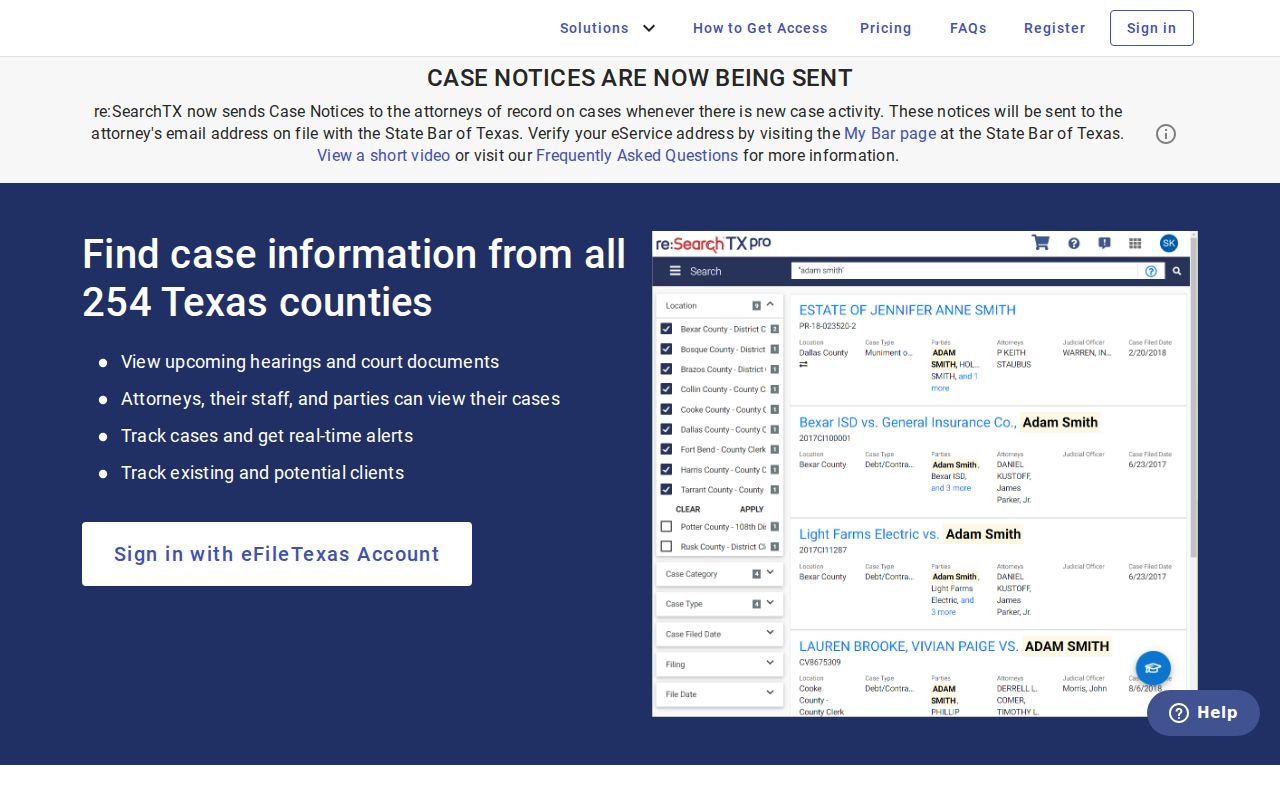
Use its results to locate a court and cause, then verify the Wharton County file with the clerk that owns it.
| Search control | Best use | Required | Wharton County check |
|---|---|---|---|
| Party name | Locate a case without a cause number | Route dependent | Compare court and filing date |
| Cause number | Reach one known docket | No | Match the full number and court |
| Court | Separate district, county, and lower courts | No | Use 23rd or 329th for felonies |
| Case type or year | Narrow a common name | No | Confirm criminal classification |
| Document access | Open docket detail or images | Role varies | Ask the clerk when unavailable |
Wharton County Misdemeanor Files
The County Clerk's Criminal Department holds Class A and B misdemeanor files from the constitutional County Court. Its office is at 309 E. Milam Street, Suite 700, Wharton, TX 77488. Public counter hours are 8:00 a.m. to 4:30 p.m. on weekdays, and telephone calls are accepted at 979-532-2381 until 5:00 p.m. The office accepts cash and major credit or debit cards for transactions.
The County Clerk criminal-record page links its own iDocket route. Its official source view identifies the correct Wharton County custodian for misdemeanor pleadings and dispositions.
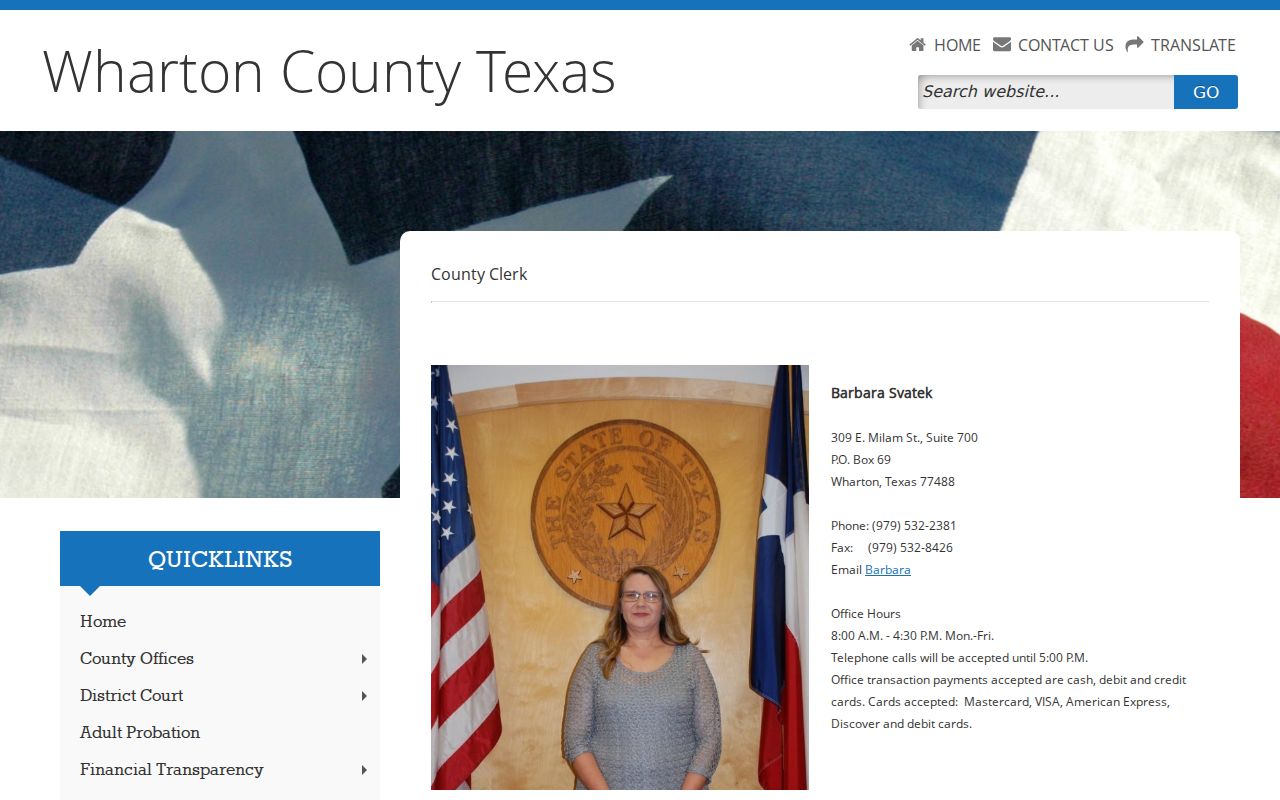
A public requester should ask the Criminal Department for current copy charges rather than applying the District Clerk's separate fee schedule.
Inside a Wharton County Case File
A court case file is organized around one cause number. It links the State of Texas and the defendant to a court, filed charge, event history, and outcome. Some public indexes expose only a docket line, while others allow selected document images. Sensitive filings may be withheld or redacted. When the result matters, obtain the charging instrument and final judgment rather than relying on a short status label.
| Cause number and court | Identifies the one prosecution and whether it sits in County Court, the 23rd District Court, or the 329th District Court. |
|---|---|
| Charging document | The complaint, information, or indictment states the offense formally filed. |
| Docket entries | Tracks settings, motions, pleas, capias events, orders, and later filings. |
| Party and counsel | Names the defendant and attorney when counsel has entered the case. |
| Disposition and judgment | Shows dismissal, acquittal, deferred adjudication, conviction, or another recorded outcome. |
| Sentence and costs | May state confinement, community supervision, fines, costs, and payment information. |
Note: A missing DPS disposition can be a reporting gap, so compare the statewide history with the signed Wharton County judgment.
Wharton Court Level Limits
Not every Wharton County criminal matter belongs in a felony search. Municipal courts in Wharton, El Campo, and East Bernard handle fine-only state-law and ordinance charges. Four justice courts also handle Class C and precinct matters. Those dockets can contain citations, warrants, or capias entries that never appear in the District Clerk's felony path.
The constitutional County Court page identifies the misdemeanor court and its criminal docket role. The image sourced from that official page helps distinguish the court itself from the clerk who keeps its record.
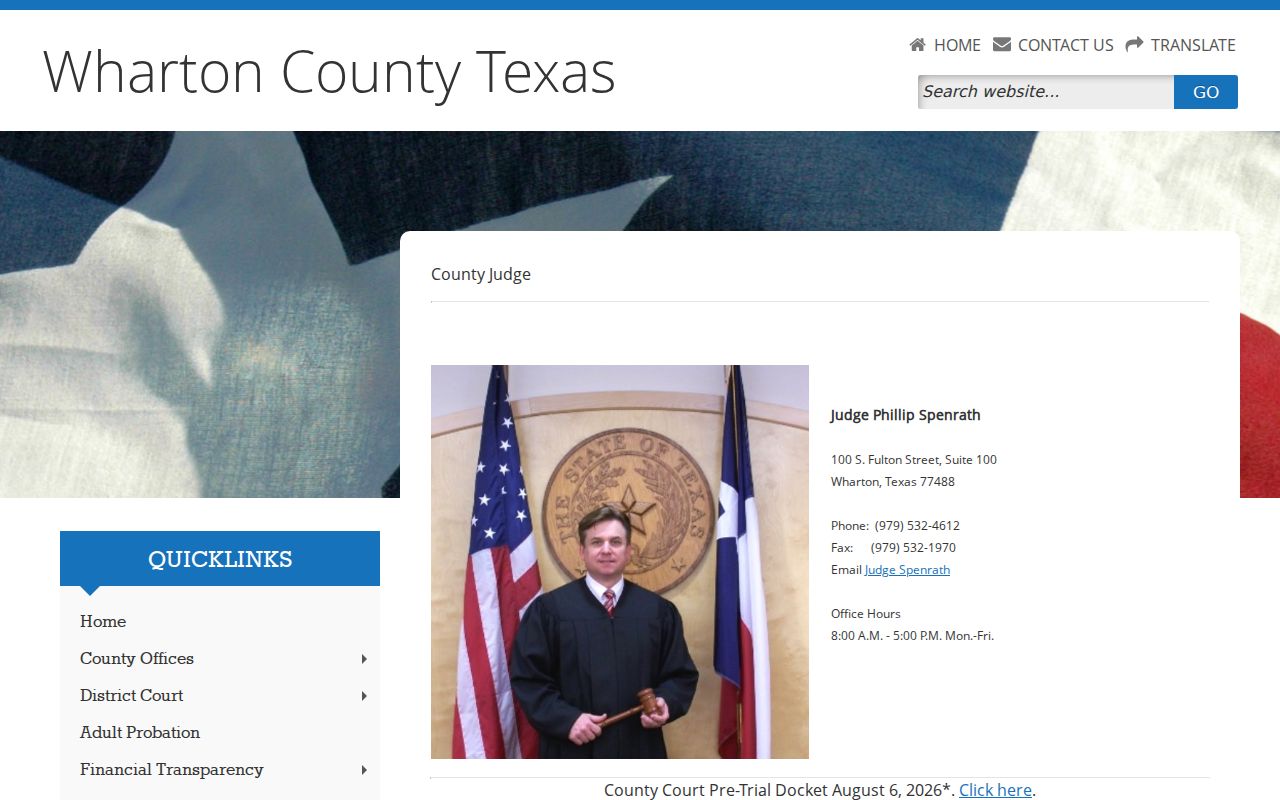
A payment screen or citation result is not the same as a complete case file. Ask the issuing court for the docket and disposition.
How a Criminal Case Moves
A Wharton County case may begin with arrest or summons, followed by magistration and prosecutor review. Article 15.17 generally requires an arrested person to be brought before a magistrate without needless delay and no later than 48 hours after arrest. A misdemeanor may proceed by information. A felony can move to a grand jury, which may return an indictment or no-bill the presented charge.
Case flow: Charges Filed → Arraignment → Pretrial → Plea or Trial → Disposition → Sentencing
The sequence matters because a booking charge can change before filing. A plea or trial produces a disposition, and a conviction should be confirmed in the signed judgment. An appeal or later order can add more entries after sentencing. For Wharton County criminal cases, the docket is a timeline, not merely a one-line verdict.
Wharton Court Disposition Terms
Short docket terms can describe very different results. Read the event date and the document tied to each term. A status field alone may lag, and the same case can contain multiple counts with separate outcomes.
- No-bill
- The grand jury did not return an indictment on the charge presented.
- Dismissed
- The filed charge ended without a conviction, though separate arrest records may remain.
- Deferred adjudication
- Court supervision proceeds without an immediate finding of guilt, subject to later court action.
- Convicted
- A judgment of guilt was entered and should be confirmed in the judgment.
- Acquitted
- A not-guilty result followed trial or other authorized adjudication.
A dismissal does not by itself erase every agency copy. Expunction and nondisclosure are separate Texas remedies with their own standards and orders.
Wharton Court Search Fees
The District Clerk's posted 2022 schedule lists a $5 civil or criminal records search, $1 per paper page, and $5 for certification. These are useful fallback figures when iDocket does not supply the needed file. Ask the clerk to confirm the current total, especially for a long file or several certified documents. Do not transfer that schedule to the County Clerk, whose current criminal-copy price must be requested separately.
A certified copy bears the clerk's authentication and differs from a printed portal screen. State the cause number, exact item, and whether certification is required. That detail keeps the Wharton County clerk from copying an entire docket when only a judgment or charging instrument is needed.
Case Record Access & Restrictions
Texas Government Code Section 552.021 supports access to governmental information unless another law creates an exception. Public access does not mean every filed detail appears online. Juvenile material, protected victim information, Social Security and driver-license data, sealed records, and some active-investigation content can be withheld or redacted.
Government Code Chapter 411 controls criminal-history dissemination, while Code of Criminal Procedure Chapter 55A governs qualifying expunctions. An order of nondisclosure restricts ordinary public access but is not the same as physical destruction. If a Wharton County case cannot be found, verify the spelling, court level, and cause number, then ask the correct clerk whether the file is archived, restricted, or held by another court.